

In total, the Central Carinthia region boasts more than 100 castles, palaces and ruins. In many places, the landscape is characterized by these stone testimonies to a great past.
In the Middle Ages, for example, St. Veit was the residence of the Carinthian dukes and also the provincial capital. One of the most illustrious of them, Bernhard von Spanheim, attracted many important personalities with his magnificent court. The nobles and knights of the province had their castles and palaces, such as Liebenfels, Glanegg, Taggenbrunn and Hochosterwitz, built around the ducal town.
Hochosterwitz Castle
Austria’s most beautiful and imposing castle – Hochosterwitz Castle – is also known in the United States, as this unique structure inspired Walt Disney when designing his Cinderella Castle.
This majestic fortress sits enthroned on a 150-metre-high rock and is protected by mighty walls and towers. However, the ingenious defense system is only one reason why the magnificent stone building was never conquered. The cunning and cleverness of the castle’s inhabitants also played their part. Many sagas and legends still tell of the gruesome stories that took place at the foot of the fortress.
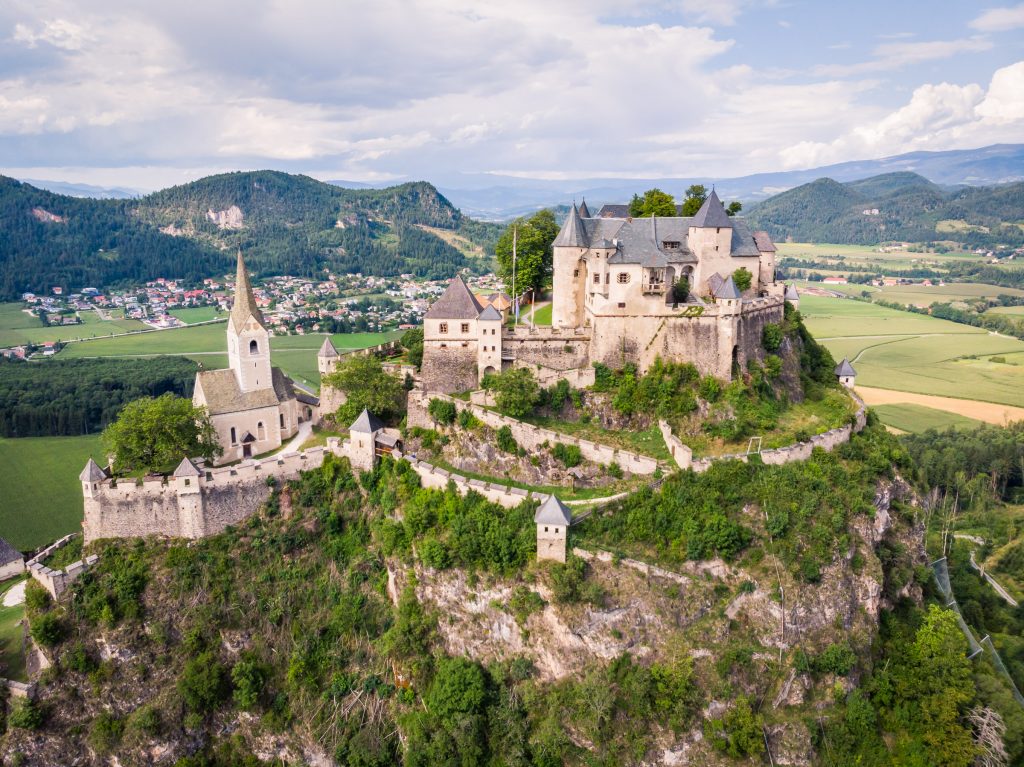
If you want to “conquer” Hochosterwitz Castle today, it is much easier. After passing through the 14 mighty gates, you can climb the castle hill safely on foot and do something good for your health at the same time. If you want to get to the top of the mountain even faster, take the “Fürst-Max-Bahn” and you will be at the top in a minute. Here you have a unique view of the countryside. You can also discover the impressive collection of weapons in the armory or stop off at the castle tavern.
Some of the monumental buildings in Central Carinthia, such as the so-called Kraiger castles, the Frauenstein, Thurnhof and Eberstein castles, the Geyersberg and Nußberg castles, are privately owned, while many others are just waiting to be discovered: Albeck Castle, Grades Castle in the Metnitz Valley, St. Georgen Abbey on Lake Längsee, which was a private count’s castle for some time, and
Strasbourg.
The castle town
Friesach has made a name for itself as a “castle town”. Not only does it still have the only 820-metre-long, continuously water-filled moat and three castle complexes, but a new castle is also being built here using medieval methods.
The castle hiking trail leadsfrom the historic town center to the town fortifications, the castles and ruins and also to the “new” castle.
Fortifications of a somewhat different kind are fortified churches, also known as fortified churches. At the time of the Turkish wars, these fortified church complexes provided refuge for the rural population. Some of these “sacred castles” are still impressive today: the