
Traditional Carinthian cheese noodles
The best-known and most traditional Carinthian dish after Reindling is Kasnudel, which is usually served on Fridays with a green salad as a side dish. The name is a little misleading, as these filled “dumplings” do not contain any conventional cheese.
Kärntner Kasnudel – The filling
Carinthian cheese noodles are only authentic with a filling made from potatoes and curd cheese in a 1:1 ratio, seasoned with a pinch of salt and a little finely chopped Carinthian pasta mint. Every Carinthian chef has her own recipe, as some swear that it is the addition of chervil, parsley, leek and marjoram, all finely chopped, that gives the real “Carinthian” taste. One tip for a successful dish is to use a dry breadcrumb casserole, such as the one offered by Milcherlebniswelt Sonnenalm in Klein St. Paul in Görtschitztal.
There are now more than 50 new varieties.
In the 1970s, the first companies began to produce and sell Carinthian pasta on a larger scale. One of these pioneers was the Ellersdorfer brothers’ family business in St. Veit an der Glan. There are now many producers and Carinthian noodles are also made without “Kas”: Savory with meat, game, goose, potato curd or Kaspress, sweet with Kletzen, nut nougat, raspberries, strawberries, apple curd and nut chestnuts or seasonal vegetarian with asparagus, mushrooms and pumpkin etc. There are virtually no limits to your imagination when it comes to fillings. Not forgetting the vegan and lactose-free versions or the gluten-free wholemeal spelt dough.
Leitgeb shows how it’s done
Genuine craftsmanship
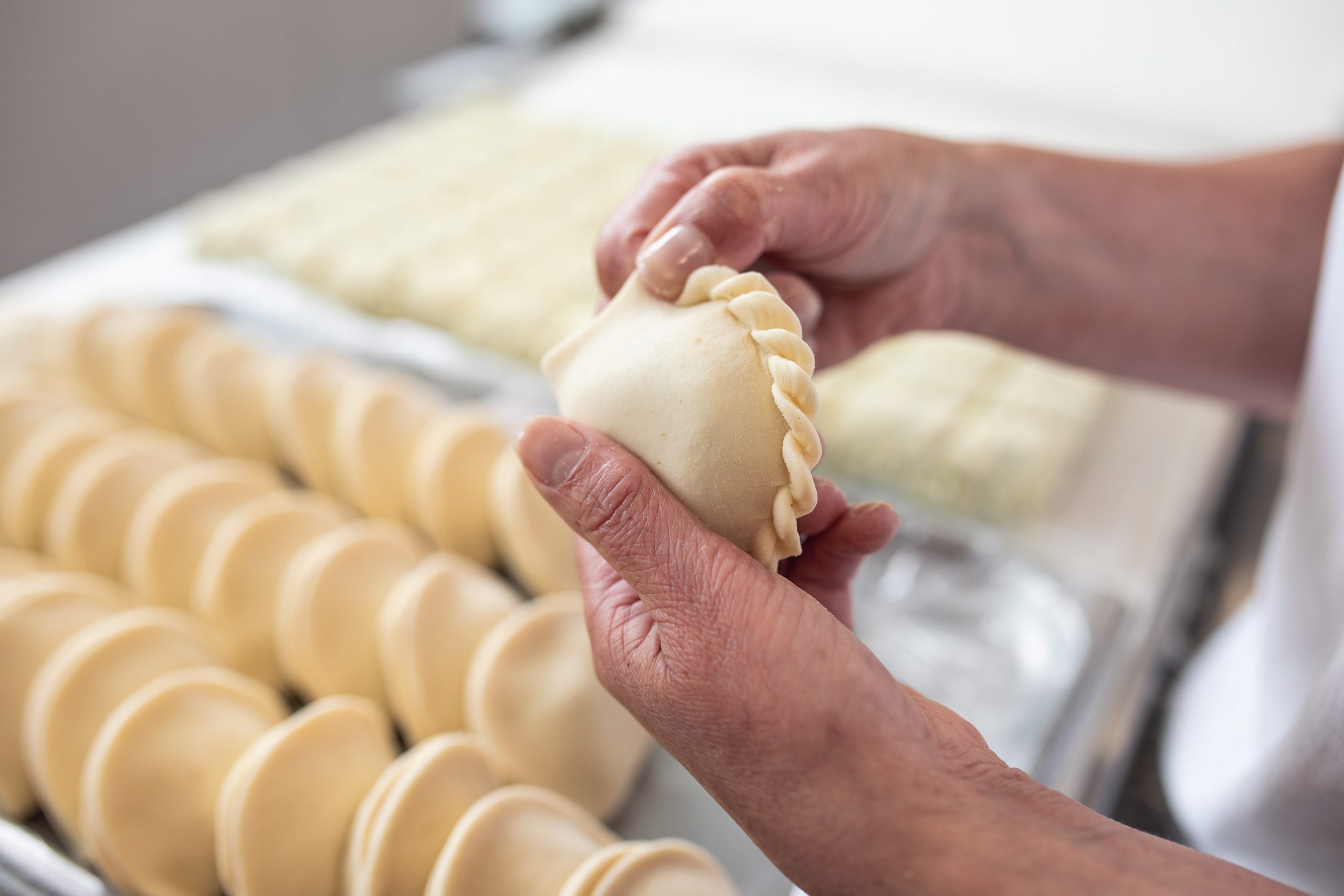
Another criterion for the authenticity of Carinthian Kasnudeln is the “Krendeln”, also known as “Grandln”. This is the “closure” of the naturally handmade noodle. “A Dirndl, dås nit krendeln kån, kriegt kan Månn”, is nowadays only said with a wink in the now emancipated Carinthia. However, nothing has changed when it comes to the art of making the cheese noodles that have been popular for centuries.
First, the filling is pressed into balls, the “Baale”, and shaped. Then small balls of dough are rolled into round pasta sheets, into which the “Baale” are placed. To ensure that the filling remains in the noodle during cooking, the two edges of the dough are pressed together centimetre by centimetre with thumb and forefinger and twisted in to form a jagged edge. The pasta is cooked in plenty of gently simmering salted water in about 10 minutes, depending on the size.
Delicacy only once a year – Görtschitztal Christmas Eve pasta
The “Görtschitztaler Heilig-Abend-Nudl” are unique and it is a shame that they are only available once a year and only in a few households in the Görtschitztal. Instead, Kasnudl is made with a curd cheese and potato filling, seasoned only with mint and Kerblkraut. After they have been cooked, they are left to dry and briefly fried in clarified butter. They are then served, drizzled with a little honey and sprinkled with grated poppy seeds.
Schaunudlerei, Krendel courses and hearty Wirtshaus noodles
Every Tuesday and Thursday afternoon, the Norische Nudlwerkstatt in Guttaring with its show pasta workshop, pasta cinema, tasting room and store offers a look behind the scenes of production. You can test your own “Krendln” skills on a Krendl course.
Central Carinthian cheese noodle producers:
Norische Nudelwerkstatt
Christophorusweg 2
9334 Guttaring
+43 4262 50052
www.nudl.at/
Nudelschmiede
Grösserstrasse 2
9334 Guttaring
+43 4262 51 215
www.nudl-schmiede.at/
Leitgeb’s Kärntnernudel
Industriestraße 18
9360 Friesach
+43 664 9188181
www.kaerntnernudel.co.at
Torbauer Nudelmanufaktur
Metnitztalerstrasse 26
9360 Friesach
+43 4268 2575
www.torbauer-nudel.at/
Gurktaler Nudelhaus Erian
Professor-Löw-Straße 1, 9342 Gurk
04266 8222
www.gasthof-erian.at/shop
Brüder Ellersdorfer
Unterer Platz 20
9300 St. Veit/Glan
+43 4212 2210
www.ellersdorfer.at/