
Blessed female figures from Wieting to Maria Hilf
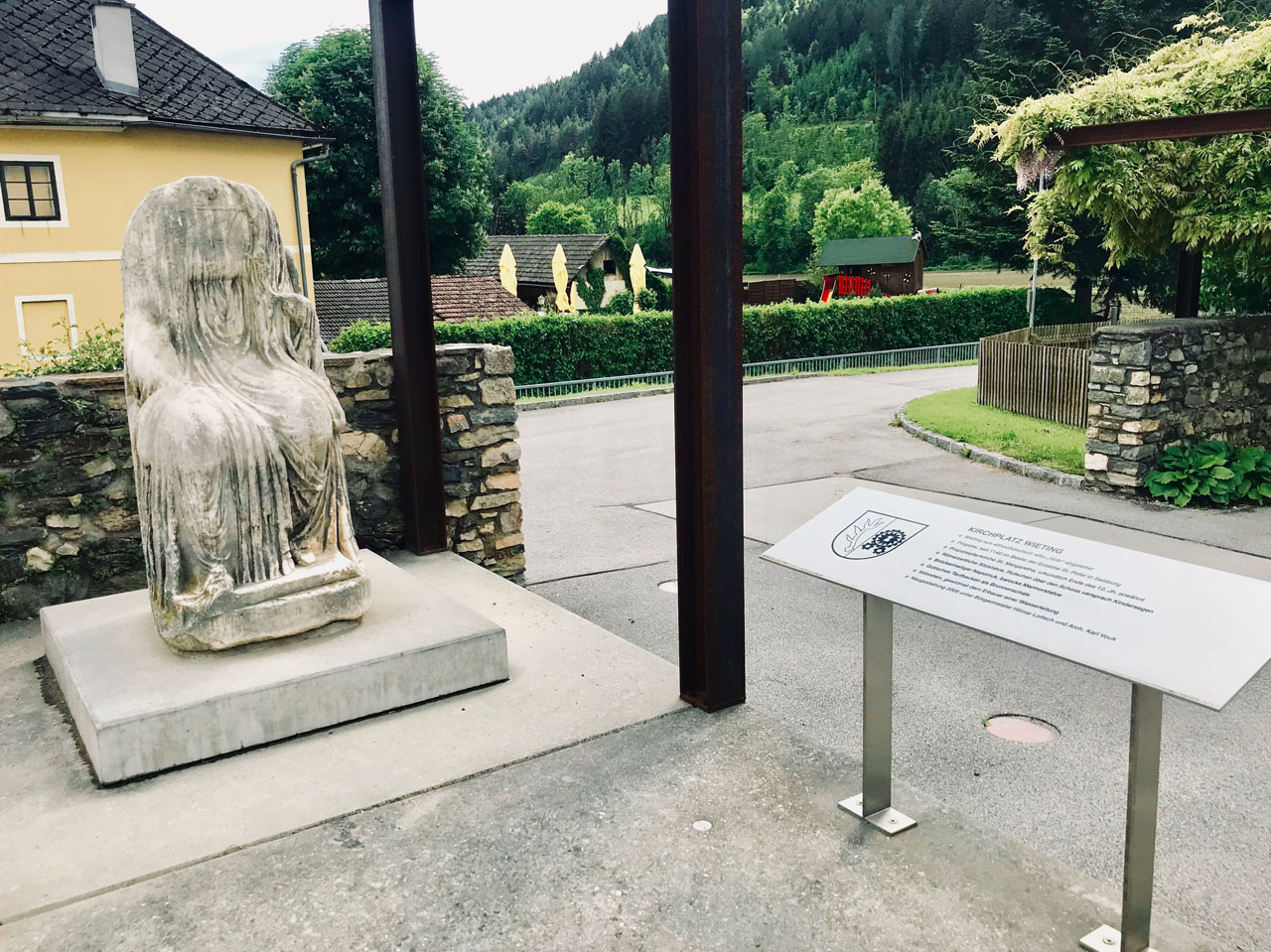
Following in the footsteps of blessed female figures, this short hike begins in front of Wieting parish church. The church is dedicated to St. Margaret, one of 14 holy helpers and the patron saint of pregnant women and women in childbirth. Right in front of the church sits the headless marble statue, the secret of which has not yet been fully revealed. For a long time, she was venerated as the Norse tribal goddess Noreia, over whose stone womb many women slipped in the hope of having children. She is now considered a Roman funerary monument. However, her mystical aura remains.
Miraculous pilgrimage site Maria Hilf
Once across the village and uphill through the forest, you soon reach the Maria Hilf pilgrimage church. This mighty baroque building in a magnificent panoramic location is many centuries old as a place of pilgrimage to the Virgin Mary. The sticks and crutches that healed people have left in the chancel bear witness to faith, private miracles and gratitude.
Their comforting fates accompany the hiker on the way back to Wieting.
More about the headless von Wieting
The thighs and knees of the huge, marble seated statue are polished smooth – from many generations of women who sat on it and slid down it in the hope of motherhood. It was found at the end of the 19th century in the bed of a local stream, where it had lain dormant for many eras.
Isis-Noreia, help!
A statue of Isis Noreia! The finders were sure of it back then. The Celtic goddess and mother of Noricum was regarded as the highest authority for fertility, among other things. Those who wanted a rich blessing of children sought out Noreia springs, young women squeezed themselves through so-called “women’s hatches”, i.e. hole rocks, to ask for a pregnancy. Or they sought out Noreia slides: Isis-Noreia was often depicted as a seated statue, so it was possible to slide across her womb.
A true Görtschitztal native
It would have been a good fit: An Isis-Noreia monument visible from afar in the middle of the Görtschitztal valley, a region where the Celts smelted Norse iron and where many believe the legendary city of Noreia was located. In the end, however, it turned out that it was probably not a fertility goddess that had been found in Wieting. Instead, it was a Roman burial statue of a local woman. The marble image of an original Görtschitztal woman, so to speak.
Of course, this did not detract from the fertility cult. They simply continued to slide around happily on her lap, and you can still see this now and again. And who knows? Maybe it still helps…
The marble statue of a woman
Church square, 9374 Wieting