
Churches as fortifications
Churches, which were built like fortified castles, provided the rural population with a place of refuge in times of war.
The landscape of the valley is characterized by numerous churches, chapels and field monuments. The many fortified churches still preserved here are a special feature. These are genuine fortified churches, some with gigantic fortifications.
The history of the fortified churches
When Ottoman troops from the east invaded Carinthia in the second half of the 15th century, the rural population was forced to help themselves. Their farms offered little protection due to the common building materials of wood and straw, as they quickly went up in flames when attacked with fire arrows. Churches, built of stone and usually with a slate roof, also had a great advantage as a defensive base due to their exposed location on hills. They became imposing building ensembles with defensive walls including embrasures and battlements and towers, and some were also equipped with dry moats or moats. The churches thus provided a place of protection and refuge in times of war.
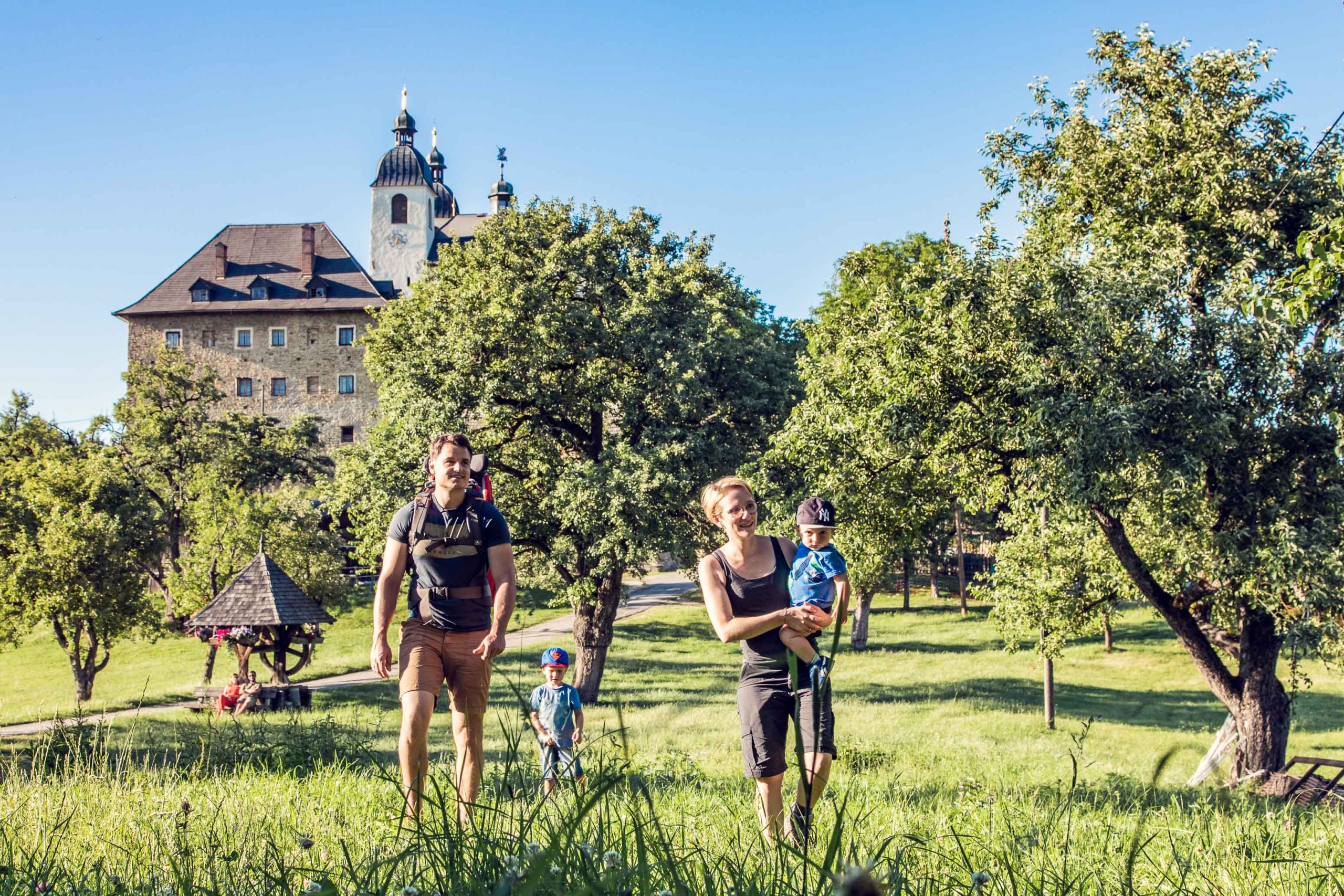
Parish church Diex and Hochfeistriz
The Diex parish church is one of the best-preserved rural fortifications in Carinthia and amazes visitors with its five-metre-high curtain wall and imposing gate. Grafenbach is located in the immediate vicinity on the southern slope of the Saualpe. Here you will find an almost completely preserved wooden battlements, which are still accessible. Another example is the ensemble in Hochfeistritz. The beautiful late Gothic church is surrounded by the mighty defensive wall, which is additionally secured with defensive towers. Built into the wall is a two-storey building with a late Gothic core, which is now run as an inn. You can also ask for the church key here.
Maria Waitschach pilgrimage church
At the pilgrimage church Maria Waitschach ob Hüttenberg, its function as a fortified church is only partially recognizable, especially as the former defensive wall has largely been demolished. Together with Maria Hilf ob Guttaring and Maria im Moos am Kirchberg, this church is part of the so-called “Mariendreieck”, whereby the latter is probably the first Marian church in Carinthia.
The valley’s churches, with or without fortified walls, are silent witnesses to the valley’s eventful history, mostly built in places of power and a source of peace and tranquillity for anyone looking to slow down.